Knowl
Uncle SilasKnowl is the ancestral home of Maud Ruthyn and her father, Austin Ruthyn, and the novel’s defining place of childhood, family memory, and comparative security. Austin’s seclusion gives the estate a quiet, tightly ordered life, while its later emptying and Maud’s departure make it the lost home against which the more restrictive spaces of Bartram-Haugh are measured.
Identity and Household
Knowl is associated with the Ruthyn family’s old lineage and inherited standing. Austin is known in the county as Mr. Ruthyn of Knowl; family tradition holds that the family repeatedly refused a baronetage and was even offered a viscounty. Maud, however, knows this history only vaguely, having picked it up from the fireside talk of old household retainers. The estate’s social identity therefore precedes her understanding of it: she grows up within a distinguished family setting whose history is present more as inherited atmosphere than as knowledge she can explain.
Austin is the household’s master and Maud’s father, and his habits shape the estate’s everyday character. He lives in remarkable seclusion, seldom leaving the grounds except for a ride, and visitors are so unusual that even a minor departure from routine prompts speculation. The quiet is not evidence that he has withdrawn from all responsibility. Rather, Knowl’s domestic order accommodates a landlord and county figure who maintains public obligations while limiting his personal social life.
Austin’s Seclusion and County Standing
Despite his reserve, Austin is widely popular in the county. He is generous with the estate’s shooting, keeps a pack of hounds at Dollerton for the local hunting season, and gives freely to charitable, social, sporting, and agricultural causes that matter to the people around him. He also answers correspondence for hours each day, often sending money in response. His long-ago service as High Sheriff further places him within county life. Knowl is thus both a secluded residence and the base of a substantial public generosity: Austin avoids company without making himself inaccessible to his neighbours.
The contrast between public reputation and private reserve is important to the house’s atmosphere. Inside Knowl, Maud sees her father’s anxious silences and unexplained concerns more closely than she can interpret them. The household’s quiet routine makes unusual arrivals and conversations conspicuous, but Austin’s inwardness leaves much of their meaning hidden from his daughter.
Rooms, Observation, and Family Secrets
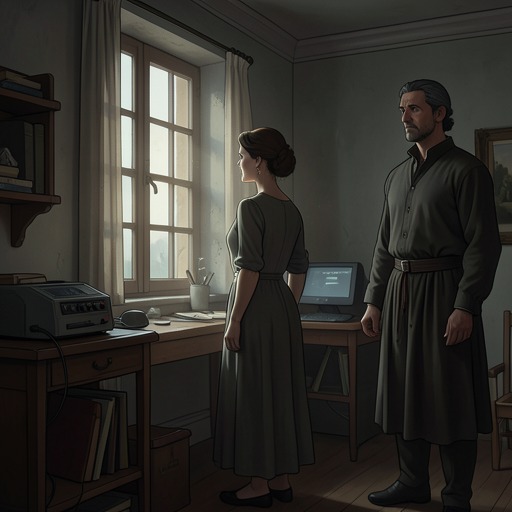
The house’s interior is presented through Maud’s gradual, partial access to its rooms. In the library, her father gives her a mysterious charge concerning the old oak cabinet. About a fortnight later, she sits alone by a drawing-room window at night, absorbed in the moonlit scene. Elsewhere, while Austin writes or appears to ponder anxiously at his desk, Maud settles into a narrow recess by the fireplace, screened on one side by an old escritoire, with a candle and a book of engravings. The arrangement lets her remain close to her father while watching him without interrupting him; the house contains both family intimacy and information withheld from the child who lives within it.
Knowl’s apparent calm is also broken by events that bring danger into its grounds. Maud later recalls that Dudley Ruthyn was seen at Church Scarsdale and among a party in the warren at Knowl on the night the gamekeeper was beaten. She connects Tom Brice’s features with those of a postilion who had looked at her during the earlier disturbance, and questions Tom about driving a carriage whose party quarrelled with the gamekeepers. Yet she becomes less confident about identifying Dudley with the man at Church Scarsdale, and the episode leaves her with uncertainty rather than a settled account. The incident matters to Knowl’s history because it makes the estate’s quiet grounds a site of intrusion and unresolved suspicion.
Death and the Emptying of the House
Austin’s sudden death transforms Knowl from a lived-in family home into a place of bereavement and impending dispersal. Maud learns that a dangerous aneurysm had been detected earlier by Doctor Bryerly; Austin knew that his death could not long be deferred but had not told her plainly. Instead, he hinted at it through an allegory of a journey, leaving words of consolation whose significance Maud understands after his death. Her first response is disbelief, followed by the insistence that the village doctor be summoned. The loss is especially stark because the house has no other family member present with her at that moment.
The death also alters Maud’s understanding of Austin. She had found him odd and difficult to read, and his silence about serious matters had made his inner life obscure. Afterward, she recognizes tenderness beneath his rugged manner. At the same time, his absence leaves her with a sudden, painful freedom in a house without its master: the physical home remains, but its central personal bond has been removed.
Departure and Contrast with Bartram-Haugh
After Austin’s death, the household is reorganized in anticipation of Maud’s departure under the guardianship arrangements made in his will. Doctor Bryerly and Mr. Danvers confer about the estate: the grounds and gardens are to be let, the house is to remain unlet under Mrs. Rusk’s care, and only a small number of outdoor servants remain. Most of the staff leave; Mary Quince accompanies Maud as her maid. The estate’s administration continues, but Knowl ceases to function as Maud’s active home.
Maud’s final morning there is marked by visible signs of a house being emptied. Doors are mostly locked, the rooms are stripped of their usual furnishings, and a charwoman washes the bare drawing-room floor. Mrs. Rusk and Branston are among the few servants still present. Before she leaves, Maud lingers to look at the house, uncertain how long it will be before she sees it again. Her cousin Monica has already departed for the railway, and their embrace and words of comfort become part of the farewells that separate Maud from her earlier life.
The contrast becomes sharper when Maud reaches Bartram-Haugh. Knowl’s rare visitors and familiar domestic routine give way to high hatches across corridors and galleries, some locked to block passage; at Bartram-Haugh, she is also confronted with a room whose windows are barred and screwed shut. She recognizes an inner court there as resembling a hotel courtyard, but the resemblance is deceptive: the room she occupies has been converted into a prison. In retrospect, Knowl’s significance lies not in being an untroubled or fully understood refuge, but in the difference between a home whose mysteries remain within a familiar household and a later estate where restricted access becomes an instrument of confinement.
Memory and Narrative Significance
Knowl persists in Maud’s account as a landscape of childhood and a measure of what she has lost. Looking back from the journey away from Bartram-Haugh, she sees its wooded uplands in the distance and associates the place with her father, her mother, and the scenes of her childhood. The memory is not wholly innocent: Maud recalls that those scenes were embittered by Madame de la Rougierre. Even so, Knowl remains bound to family affection and an earlier sense of belonging, unlike the later estate where access, movement, and communication are controlled.
The novel makes that contrast spatial as well as emotional. At Knowl, Maud can sit in a recess near her father’s desk, notice his anxiety, and move through a household whose routines she knows, even when she cannot decipher their secrets. At Bartram-Haugh, locked barriers and secured windows make the restrictions physical and inescapable. Knowl’s departure is therefore a decisive threshold in Maud’s story: it ends her life in the home shaped by Austin and begins the journey into dependence on a guardian whose estate imposes a radically different order.